
Table of contents
- Introduction: Why brand loyalty matters
- Why community builds loyalty better than discounts
- Audience vs. Community
- Member-to-member value
- Why Facebook Groups specifically
- Community as a long-term business asset
- Broadcasting vs. gathering
- Facebook Groups across the customer journey
- Profile vs. Page vs. Group
- Is a Facebook Group right for your business?
- Build the foundation
- Embedding Your Facebook Group into Your Business Ecosystem
- Turning Trust into Conversions Without Breaking the Community
- Measuring What Actually Matters
- Conclusion
- FAQs
Loyal customers are the backbone of a healthy business, but Loyalty is not something you can simply announce into existence or sprinkle on top with a discount code. A discount might win the sale today, but when the offer ends, the reason to come back often goes with it.Competing only on price turns loyalty into a game where everyone keeps searching for the next cheaper option. And there is always someone willing to cut the price a little further. Community, however, works differently. It gives customers a reason to stay connected beyond the transaction. When people feel connected to a brand and, just as importantly, to the people around it, the relationship starts becoming something more than a simple exchange of money for a product. A customer recommends your service to a friend who is still deciding. Someone answers a newcomer’s question before your team even sees the notification. Another member shares a small win that gives someone else the push they needed to keep going. The business is no longer carrying the entire conversation on its shoulders. Customers start creating value for each other and that is where loyalty begins to take root. A strong Facebook community becomes more than a place where updates are posted and announcements are shared. It becomes a space people return to because they find conversations worth coming back for. In this guide, I’ll walk you through how to build a Facebook community that strengthens brand loyalty, from defining your purpose to creating conversations members actually want to join.
Why Brand Loyalty Is a Competitive Advantage
Getting new customers is expensive, keeping the ones you already have is where long-term growth starts to compound. Loyal customers do more than purchase again. They recommend your brand, share their experiences, offer feedback, and become the people introducing others to your business. They become your unofficial marketing team. The challenge is that loyalty cannot be demanded. Nobody wakes up thinking, “Today, I will become loyal to a company. “It happens through repeated positive experiences. Customers stay loyal when they feel understood and believe they are part of something valuable and a Facebook community creates room for those moments to happen.
Audience vs. Community
The distinction becomes much clearer when viewed side by side. An audience primarily consumes content, while a community contributes to it.
In an audience:
- Communication flows largely from the business to its followers.
- Engagement revolves around individual posts.
- Members may never interact with one another.
In a community:
- Members ask questions and share experiences.
- Conversations continue beyond the original post.
- People help one another solve problems.
- The business becomes a facilitator rather than the only voice in the room.
It may seem like a small distinction, but in the attention economy, it changes everything. One is built on reach, the other on participation, and each shapes customer behavior in very different ways. When members begin helping other members, the business no longer has to lead every conversation. Participation becomes shared, and relationships deepen naturally through ongoing interaction. Richard Millington consistently argues that healthy communities create value through member-to-member relationships, not solely through interactions between the organization and individual members. In other words, the strongest communities create the conditions for members to learn from one another, celebrate progress, exchange advice, and contribute experiences that make the community richer than any single post ever. Those interactions may seem ordinary on their own, but they outlast any marketing campaign: a community worth joining and coming back to. Because when conversations no longer end abruptly at checkout, loyalty has room to grow.
The Business Case for Facebook Groups
Facebook Groups are not complicated to set up, and that’s part of the appeal. They are free to create, and they give businesses a structured space for ongoing interaction that doesn’t vanish the moment a post leaves the feed. Unlike one-off posts that rely on timing or platform behavior, Groups create continuity. The conversation stays in one place, rather than fading into an endless stream of social feeds. With that said, do these groups—with all their grandiosity of utility—guarantee immediate outcomes that outshine every channel? Not necessarily. But they do create a far more stable environment for engagement over time. Wes McDowell frames Facebook Groups as a way of bringing your most engaged audience into one concentrated space. Forget the rat race of reach and traffic; people already showing signals of interest in your business are often scattered across a noisy feed, and just bringing them together is half the battle This whole idea of Groups comes down to one principle: concentration of attention, keeping your most engaged audience in a space where the conversation doesn’t get buried the moment the algorithm clears its throat.
Community as a Long-Term Business Asset
Most social media content has a short attention window. The flow goes like: you post, it performs, and then—what next? It sinks into the feed, replaced by the next thing. A Facebook Group works differently. Individual posts may fade into the background over time, but relationships and shared knowledge continue to build. Four things start to endure:
- Discussions that can be revisited
- Relationships between members
- Shared experiences and problem-solving
- Member-generated content and insights
Over time, this creates something closer to a living archive than a content feed; neither a campaign nor a post cycle. More like a long-running environment where value keeps multiplying, as long as someone is tending to it.
Broadcasting vs. gathering
“Don’t make the mistake of talking at the members. I want you to include them too,” Wes McDowell says. Traditional Facebook Pages are built around broadcasting—pushing updates outward and hoping they stick at the right moment. That model gets completely reworked with Facebook Groups. No more speaking into the void, you’re gathering people who already share a context, a need, or at least a mild curiosity that brought them there in the first place, a very normal human behavior, just given a room to speak in. Instead of: “Here’s what we’re announcing today “It becomes: “Here’s something we can actually talk about together”. It may seem like a small distinction, but in the attention economy, it changes everything. One is built on reach, the other on participation, and each shapes customer behavior in very different ways.
Facebook Groups Within the Customer Journey
The blueprint for a successful Facebook community should support different stages of the customer journey, including:

At each stage, the Group plays a different role—from reducing uncertainty to increasing familiarity, which strengthens post-purchase relationships in a way ads wish they could. Importantly, it works alongside multiple channels: your website, email marketing, booking systems, CRM tools.
Facebook Profile vs Facebook Page vs Facebook Group
Many businesses treat Facebook as though every feature should solve every marketing problem. Profiles, Pages, and Groups may live under the same roof, but they were never hired for the same job. Each serves a different purpose in the customer journey, and expecting one to replace the others creates gaps in the experience. Customers may not find the right information at the right time, making it harder for them to move forward.
Facebook Profile
Purpose: Personal relationships, this is your digital handshake.
Useful for:
– Networking
– Humanizing the business owner
– Direct relationships and trust-building
People aren’t evaluating your business here as much as they’re sizing up the person behind it. In local business, trust usually shakes hands with a person before it signs up with a brand.
Limitations:
It was never meant to carry an entire business. Push it too far and your networking list starts looking suspiciously like a CRM wearing a name tag.
Facebook Page
Purpose: Public business presence, this is your storefront that never sleeps.
Supports:
– Business information
– Reviews
– Announcements
– Advertising
– Discovery
It’s where potential customers run their own background check before deciding whether you’re worth contacting. You showcase your services and run advertisements. Facebook’s algorithm decides how many people actually see them—a reminder that broadcasting and being noticed aren’t always the same thing.
Facebook Group
Purpose: Community
Supports: – Discussions- Peer interaction
– Customer education
– Long-term engagement
– Member participation
How They Work Together
Relying on only one of these is like expecting one tool to replace an entire toolbox. Useful, absolutely. Sufficient, rarely.
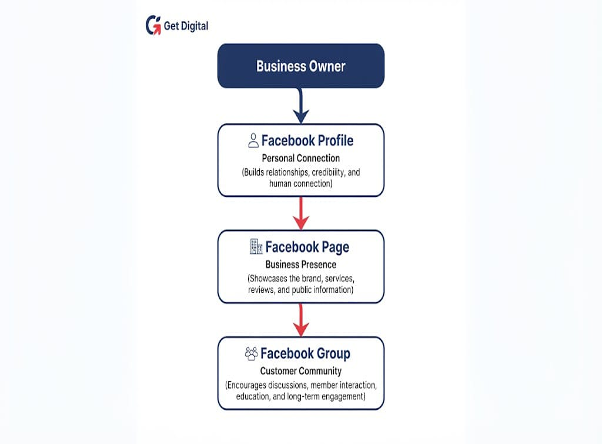
Each serves a different purpose.
– Profile introduces the person behind the business.
– Page introduces the business itself.
– Group keeps the relationship alive long after the introductions are over.
Is a Facebook Group Right for Your Business?
Facebook Groups work best when your business depends on recurring interactions and continuous support, such as salons, gyms, clinics, coaches, and local service businesses. They give these relationships a place to grow, allowing each interaction to build on the last.
Businesses That May Not Benefit as Much
Sometimes creating a Facebook Group is like setting up a weekly meetup for people who only wanted a five-minute transaction.
Groups may be less effective when:
– Transactions are primarily one-time.
– Services are emergency-based.
– There is little reason for ongoing discussion or education.
– No one has the time to consistently moderate conversations.
Questions to Ask Before Launching
Before creating a Group, ask yourself:
– Can members genuinely help one another?
– Will people have a reason to return next week?
– Can we consistently share something worth discussing—not just promoting?
– Can someone actively guide conversations?
– Is our audience actually spending time on Facebook?
If most answers are “no,” don’t force it. A good strategy can’t compensate for a missing reason to gather people in the first place.
Build a Strong Foundation
Creating a Facebook Group is no difficult task, but whether your members actually return is an entirely different matter. Facebook provides the stage, but strategy determines whether the audience participates or slips away into diminishing attention spans elsewhere. Before you click “Create Group,” it is worth pausing to define what you actually want your community to become. A Facebook Group should carry a clear identity, almost a persona of its own. Without it, members arrive, glance around, and leave without a second thought, like guests at a gathering where no one knows who the host is. Many groups succeed at earning the first click; far fewer succeed at earning the second visit. Every return after that is a corollary of genuine value creation.
Every thriving community is built around a few essential elements:
- A clear and memorable name
- A specific purpose
- A well-defined target audience
- A consistent brand voice
A clear value proposition for the community should focus on the outcomes members are looking for, creating a space that serves their needs rather than simply extending the business’s marketing efforts. These elements should reflect the interests of members rather than merely echo the business behind them. Consider a dental practice named ABC Dental Clinic. A group called ABC Dental Clinic Customers describes the institution, not the experience. In contrast, Healthy Smiles for Families in [City] immediately signals relevance and benefit. People rarely join communities to admire a logo. The underlying exchange is far more pragmatic: attention and time are traded for value. Members join to solve a problem, gain knowledge, or connect with others who share the same concerns. If that value is absent, engagement begins its slow decline, and eventually, participation goes galloping away. Once identity is defined, the mission becomes the community’s compass. It explains why the Group exists and serves as the foundation for every decision that follows. Expectations describe the lived experience of members, while rules define how interaction should occur. Together, these three elements create structural consistency for both members and moderators. Without them, conversations drift—often in directions far removed from the purpose that originally brought people together. Community strategist Yhennifer Mendes argues that a clearly defined mission should influence everything: content planning and long-term growth. In many ways, the mission becomes the standard against which every idea is measured. If an activity feels antithetical to the mission, it does not belong—no matter how engaging it might appear in isolation. With identity established, attention moves to configuration. One of the earliest decisions is privacy. Public Groups are easier to discover and allow conversations to remain visible, making them suitable for businesses seeking awareness and reach. Private Groups, on the other hand, create a stronger sense of exclusivity and often encourage deeper discussion because entry requires approval. Neither is inherently superior; each produces different behavioral outcomes depending on intent. Discoverable Groups appear in search and recommendations, while hidden Groups operate more like invite-only spaces. The distinction comes down to philosophy rather than technical setup: whether you want: whether you want discovery at scale or controlled participation. First impressions are notoriously difficult to revise. Before a member reads a single post, they have already formed a judgment based on your Group’s name, cover image, and description. These early signals determine whether the community feels credible, and worth the time investment; if not, attention pivots elsewhere.
A strong Group description should answer four essential questions:
Who is this Group for?
What will members learn or discuss?
What conversations belong here?
What should members expect after joining?
Clear expectations function as a stabilizing force. Good community guidelines are not merely a list of prohibitions; they are a social contract that allows strangers to participate without hesitation. By clarifying communication norms, acceptable content, and boundaries of behavior, you reduce uncertainty and prevent most moderation issues before they arise. As the community grows, moderation becomes about maintaining consistency and standards.Administrators define direction, while moderators maintain the rhythm of conversation and uphold standards. Community expert Rosie Sherry observes that strong communities are rarely built through strict enforcement alone. Instead, they emerge from repeated patterns of behavior that members naturally mirror over time. Finally, membership questions should be used with intention. The goal is not to collect excessive data, but to gather just enough insight to understand who is joining and why. A few concise questions such as What brought you to this Group? What would you like to learn? or Which city are you located in? —can improve onboarding while maintaining ease of entry. By the time your Facebook Group is ready to launch, it is a space with intent. A defined identity and a consistent tone of interaction form the foundation upon which all future engagement depends. Without that foundation, even strong content begins to diminish in impact, and attention eventually disperses.
Launch Your Community and Build Early Momentum
If you think a Facebook group will automatically transform into a community the moment it is created, that thinking is flawed. At its nascent stage, it is only a container—empty and waiting for members to shape it through their behaviour and interaction. It is for you to determine whether it becomes a living space or gives in to dormancy as yet another inactive group people forget they joined. The biggest mistake you can make is treating launch as a public announcement rather than a controlled beginning. If members arrive to silence, they rarely interpret it as an early stage, but as a clear lack of activity. And attention, once unimpressed, rarely returns. So before you invite anyone at scale, you have to seed the space. This means you create early activity so the Group already feels alive such as making a few posts, or asking questions. This warm-up activity tells people, in a way, that there is life here, not an empty shell waiting to be filled. Your first members matter disproportionately. They set the tone faster than rules ever will. If they engage, others will follow. Remember, Communities do not scale from zero evenly, they either tip into activity or stall completely.
So here is a practical starting point: begin with people who already have a reason to care, being specific about who they are:
- Existing customers
- Email subscribers
- Loyal followers
- Partners or collaborators
- Team members
- Closely aligned contacts
These people can be called your stabilizers. Building momentum depends more on familiarity than reach. Basically, you are activating people who already have context, and a sense of belonging in relation to your work. Promotion should not rely on a single announcement. One message is rarely enough for action, and expecting it to work in isolation underestimates the enormity of attention fragmentation today.
Instead, the Group should appear repeatedly where attention already exists:
- Website banners or landing pages
- Email newsletters
- Social media posts and stories
- Purchase or booking confirmations
- QR codes in physical environments
Repetition, in a peculiar but predictable way, builds familiarity and that is how communities get etched into people’s minds. Digital strategist Wes McDowell often frames this differently: instead of scattering attention across platforms, bring your most engaged audience into one shared space. The logic is oddly simple, fragmented attention weakens relationships; concentrated attention strengthens them. But getting members is only the beginning. What they experience immediately after joining matters more than the invitation itself. Imagine, being specific, members joining and finding nothing to do, and quietly disappearing without complaint. No friction, no feedback—just absence. That leads to diminishing interest that was never activated in the first place. A strong onboarding moment prevents that.
At minimum, new members should immediately see:
- A pinned welcome post that sets tone and context
- A clear first action (usually introductions)
- A simple question they can answer immediately
- Visible expectations for participation
- One or two helpful resources
- Then comes the most important mechanism: lowering the barrier to speaking.
Most people will respond if the entry point is simple. So you ask easy, low-pressure questions:
Where are you from?
What brought you here?
What are you hoping to learn?
That small interaction is often the difference between passive membership and active participation. Not everyone will engage immediately and they are not supposed to. Some members observe before they contribute, and that is normal behaviour. But early micro-interactions still matter because they establish the first pattern of participation. Community strategist David Spinks notes that the first action a member takes often sets the tone for everything that follows. If that first step is simple, the probability of continued engagement increases significantly. Once activity begins, structure becomes essential: pinning important posts and centralizing information such as frequently asked questions ensures members are not repeatedly searching across conversations. Without this, access to information becomes fragmented. Otherwise, your community can experience gradual withdrawal. People stop participating without explicitly leaving, which is a more severe form of disengagement. In your first 30 days, the best approach is to avoid fixating on numbers.
Week 1 is orientation—members arrive, observe, and test the space.
Week 2 is activation—small participation begins.
Week 3 is reinforcement—members start responding to each other.
Week 4 is reflection—you review what didn’t work and what needs adjustment.
By the end of this phase, the Group should feel occupied and socially alive, something is happening here, even in subtle motion. In a way, even mild activity is enough to keep the system moving and prevent stagnation.
Keep the Conversation Moving
Launching your Facebook Group is only the opening act. The real grind begins when you have to keep people talking. A quiet community is a bit like an empty restaurant—passers-by assume the food cannot be that good. Whether that assumption is fair is beside the point; perception often wins. After all, people rarely queue outside an empty building out of curiosity. So the next step after forming the group is fairly simple to understand: give members a reason to return and something worth responding to. Every post should start a conversation, not end one. For example, imagine you own a local physiotherapy clinic. Posting, “Appointments available this week,” informs members, but the conversation ends there. Instead, ask, “What’s one stretch you swear by after sitting at a desk all day?” Members begin sharing their routines, others compare experiences, and the clinic naturally joins the discussion with professional advice.
For instance, a real-style thread inside such a group often looks like this:
Post: “What’s one stretch you do after long sitting hours?”
Member A: “Honestly just standing up and cracking my back 😂”
Member B: “Hamstring stretch at my desk, otherwise I feel stuck all day”
Member C: “I didn’t know this was causing my lower back pain until now”
Clinic reply: “That lower back tension is very common—try a 30-second hip flexor stretch before and after work”
This is what a living community looks like, your business now becomes part of the conversation instead of sounding like another advertisement. Members are far more likely to remember, and eventually choose businesses that consistently contribute useful advice rather than repeatedly asking for a booking. Advice earns attention; advertisements usually compete for it. The same principle applies whether you run a dental practice, garage, salon, veterinary clinic, or café. Reading advertisements is probably the last thing people join Facebook Groups for. They are far more invested in exchanging experiences and finding practical solutions. When your business contributes to those conversations instead of interrupting them, trust—the precursor to a sale—grows naturally.
A few practical ways to keep conversations moving:
- Ask questions based on real experiences rather than questions with obvious answers.
- Encourage members to reply to one another instead of answering only you.
- Use polls for quick, low-effort participation.
- Acknowledge comments with replies or reactions so members know their contribution matters.
- Occasionally ask members to compare experiences or share what worked for them.
Remember, consistency beats occasional brilliance. No matter how excellent a single post may be, one outstanding post every month cannot compete with steady, useful conversations every week. Members vividly remember communities that keep showing up because repeated interactions gradually leave an imprint on their minds. Familiarity, in a peculiar way, becomes trust. Another point worth noting is content variety. If every post asks people to book an appointment or follows the same format, members gradually scroll past without paying attention. Even the best song loses its appeal when it is played on repeat and your content is no exception.
A healthy content mix includes:
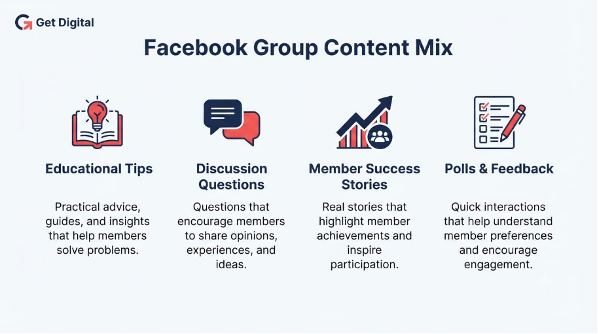
Each format serves a different purpose. Educational posts build credibility, discussion posts encourage participation, success stories create social proof, polls generate quick engagement, and business updates keep members informed without overwhelming them with promotions. The goal is to create valuable conversations that give people a reason to return and participate. By using the approaches shared above, you are promoting your business naturally while actively building a community. In the long run, people may forget a promotional post, but they rarely forget the business that consistently helped them solve a problem.
Embedding Your Facebook Group into Your Business Ecosystem
After labouring away to build a Facebook Group, many business owners look at it through the wrong lens, they treat it as a side project called “post in when they remember “. Simply put: Facebook Groups are not just another marketing channel starving for your attention. To unlock their real value, you have to embed them into the customer experience itself, connected to everything else your business already does. Think of your marketing as an ecosystem where every channel has a specific job. Your website helps people understand your business and decide whether they trust it like your booking or appointment system turns that interest into action. Your email newsletter keeps communication structured and direct and your social media pages help new people discover you. And your Facebook Group? That’s where the relationship continues after discovery. Unlike most platforms where attention is temporary and disposable, a Facebook Group creates continuity so returning and responding becomes naturally easy for your clients, who slowly start recognizing both you and each other. So every touchpoint in your business should quietly point people toward ongoing conversation—not just one-off transactions.
In practical terms, embedding your Facebook Group is repetition done right:
- Add a “Join our community” link on your website
- Include it in booking confirmations and thank-you emails
- Mention it during appointments when relevant ( as continued support)
- Feature it in newsletters as a space for advice and discussion
- Add QR codes on invoices, receipts, packaging, or reception areas
- Occasionally invite social media followers to continue discussions inside the Group
And importantly—you are extending an already existing relationship so your clients see clicking “join the group” as a continuation of an experience that has already started, of course without feeling any pressure.
A salon client can stay connected for hair-care advice between appointments. A physiotherapy patient can discuss recovery progress with others in similar situations. A garage can share maintenance tips while customers exchange real-world experiences. This naturally supports the customer journey as well, but not in a rigid or overly structured way: some people will observe and will eventually become customers, while others will remain customers who also contribute, and in a rare but plausible scenario some may never buy again, but still recommend you because the experience stayed useful long after the transaction ended. People move in loops, and a Facebook Group simply keeps that loop open instead of letting it close too early. As marketing strategist Wes McDowell often highlights, businesses grow more sustainably when they deepen relationships with existing audiences instead of constantly chasing new ones. A Facebook Group fits that principle perfectly by shifting attention away from algorithms and advertising cycles, and toward something far more stable—ongoing connection with people who already know you.
Turning Trust into Conversions Without Breaking the Community
As a local service provider, you should know that your Facebook group lets people slowly decide whether you are worth buying from. Because in local businesses, clients often suffer from uncertainty. They’re unsure if it will work, if it fits their situation, or if they’re about to pick the wrong provider and spend the next three days second-guessing it. A well-run Group removes that uncertainty over time. Trust comes before conversion, not alongside it. Most businesses make the mistake of mixing trust-building and selling in the same breath. One post educates, and the next one pushes an offer. With this cycle in action, your group is basically doing emotional gymnastics until it collapses. In a community setting, trust is built through repetition; so with these four yardsticks they judge you:
- people see you answer real questions
- they observe how you explain problems
- they notice how you handle different situations
- they watch other members interact with you
Collectively, these form a perception: “These people actually know what they’re doing “. Which converts later on—without marketing. Yes. Offers only work when they feel like a continuation. In a Facebook Group, the worst kind of promotion is the standalone announcement. It breaks the flow and makes your audience feel like they just walked into a conversation that suddenly turned into an infomercial. Instead, offers should appear as natural extensions of current or past discussions.
For example:
- A salon answering hair damage questions can guide customers toward a repair treatment.
- A gym discussing posture issues can help members discover a structured program.
- A physiotherapist explaining recovery pain can connect patients with guided rehab.
- A garage discussing seasonal breakdowns can recommend a maintenance service
So the mantra is: The Group should feel like a problem-solving space where solutions are also available.
Reframe soft selling
There is a misconception that avoiding hard selling means avoiding selling altogether. You are still selling but in a way that respects context without trying to elbow its way into the conversation. Soft selling waits for relevance, and in a Facebook Group, it is basically timing with manners. Because when someone sees your offer exactly when they are already thinking about the problem, it doesn’t feel like persuasion. It feels like the universe (or at least your admin) reading the room correctly. If this is handled well it becomes a place where problems are resolved and choices feel obvious, not forced. It becomes something that happens as a byproduct of participation.
The Three Systems That Make a Facebook Group Run Without You
That’s the illusion most people fall for. They think a Facebook Group survives because the admin keeps posting. On the contrary, more posting usually doesn’t create community; shocking but true: a group becomes self-sustaining when the interaction load moves away from the admin and spreads across the members themselves. So the transition is from running the group to maintaining the conditions where it keeps running itself like a system that has learned to breathe on its own without being nudged every few hours. Three mechanisms make this possible. If any one of them is missing, the group slowly slips back into a content page pretending to be a community.
- The Trigger System — “Something must start the conversation”
Silence and dormancy are a big no for your Facebook Group. The trigger system ensures your posts act as social ignition points, creating situations people actually feel pulled to respond to, not just scroll past without a second thought. Most admins just try to inform; you have to provoke interaction, as humans don’t engage with information alone; they interact with what feels debatable, or slightly too real to ignore. So, the “Here’s what you should know,” posts are to be replaced with the “What would you do here?” or “Has this ever happened to you? “posts. Because the goal is to turn passive readers into first-time participants.
Trigger System in practice
- Relatable problem posts that mirror real-life situations
- Opinion prompts that invite disagreement or shared experience
- Scenario-based questions (“what would you do?” style posts)
- Experience requests (“has this happened to you?” style posts)
- The Member Loop System — “Members talking to members, not through you”
Letting your group become a one-man broadcast channel with comments attached, where the admin is running every conversation in the background, is the worst thing you can do for your group. The member loop system breaks that pattern. It’s where members start responding to each other before you even show up. Sometimes that means deliberately stepping back. Because if you always rush to fill every silence, you accidentally train people to wait for you instead of talking to each other. At this stage, recognition becomes more powerful than replies. Highlighting a member’s comment often drives more engagement than replying to it yourself ever will.
Member Loop System in practice
- Members answering each other’s questions before admin intervention
- Experience-sharing between members (horizontal conversation flow)
- Admin highlights member comments instead of dominating replies
- Threads evolving naturally without central control
- The Rhythm System — “Consistency that doesn’t depend on your mood”
Doing a big push on Monday and then ghosting your group until Thursday is a recipe for disaster. Trying to rely on motivation to maintain consistency is a losing game from day one. What works is cadence: a predictable pulse that people can rely on, and over time, trust starts to build. This is where scheduling tools earn their place, acting like backup batteries for human inconsistency.
Rhythm System in practice
- Scheduled posts to maintain consistency (Meta Business Suite / Buffer style tools)
- Recurring formats (weekly prompts, theme days, Q&A slots)
- Light-touch updates that maintain presence without fatigue
- Predictable engagement windows that build user expectation
Measuring What Actually Matters (Without Killing Your Community)
We all know that tracking these metrics gives marketers and business owners a nice little dopamine hit. It’s easy to fall into the luring cycle of watching member count and impressions like things are growing, even when nobody is actually talking to each other. But in a real service-based community, size is the easiest illusion to manufacture. Behaviour is the real metric, what you should actually care about is whether your group can survive without you constantly feeding it. But can we even call it a community? If members start replying to each other, and sharing experiences without your intervention, that’s the point where the group starts becoming a living system. Business results matter, but they are a side effect of that behaviour, not the cause.
What you should actually track (ignore vanity metrics)
- active members per week (not total members)
- member-to-member conversations (not admin replies)
- repeat contributors (people who return to engage again)
- depth of threads (real discussions, not one-line comments)
- posts that continue without you steering them
Business signals (secondary, not direct control metrics)
- repeat customers mentioning the group
- referrals coming through members
- enquiries influenced by group discussions
- bookings or visits linked indirectly to community trust
30-Day Execution SOP (From Measurement to System)
A structured 30-day rollout that turns everything you’ve built so far—interaction and member behaviour—into a self-sustaining loop.
WEEK 1 — FOUNDATION (SET THE BEHAVIOUR)
This week is about setting behavioural rules.
- Define 1 clear purpose (why this group exists in one sentence)
- Pin a welcome post explaining how to participate
- Set 3–5 simple behaviour rules (keep it human, not corporate)
- Post 2–3 trigger posts (questions, scenarios, opinions—not information dumps)
- Respond early to set tone, then deliberately reduce dependency on replies
Outcome:
Members understand that the group is designed for genuine conversations.
WEEK 2 — ACTIVATE INTERACTION LOOPS
- Now the group stops being a broadcast space and starts becoming reactive.
- Post scenario-based or opinion-based prompts regularly
- Ask for experiences, not just answers
- Encourage members to reply to each other, not only you
- Highlight useful member comments publicly
- Identify first repeat contributors and engage them lightly
Outcome:
Members begin interacting inside the group, not just with the admin.
WEEK 3 — TRANSFER OWNERSHIP
- This is where most groups fail—because the admin doesn’t step back.
- Reduce posting frequency slightly (create space for member activity)
- Let member responses appear before you intervene
- Stop replying to every comment
- Highlight member-to-member discussions instead of controlling threads
- Share only 1 high-value insight post ( breakdown, or lesson)
Outcome:
The group starts functioning without constant admin direction.
WEEK 4 — NATURAL CONVERSION LAYER
- Now trust is already formed making selling more contextual.
- Do not post standalone promotional content
3.Only introduce services inside ongoing discussions
- Respond to problems with solutions, not pitches
5.Frame offers as continuation of conversations already happening
6.Observe which topics signal buying intent
Outcome:
When the experience feels relevant, conversion becomes a natural outcome.
WHAT SUCCESS LOOKS LIKE
If the system is working, you will see:
- Members replying to each other without prompts
- Conversations continuing without your presence
- Repeat contributors forming naturally
- New members joining active discussions instantly
- Engagement distributed across the group instead of concentrated on admin posts
Inside a Facebook community, the role of a brand is to create the space and guide the conversation. The members are what give that space meaning. When your audience feels like they belong, they carry the relationship beyond the transaction, and that is where brand loyalty begins to form.